
The Politics of Looking
The Glass RoomThis flow traces photography, public witnessing, and physical observation as different ways of seeing people without necessarily understanding them.
increasing Bearing strength in each event
 decreasing
Bearing strength in each eventdecreasingThe Honeymoon Photograph
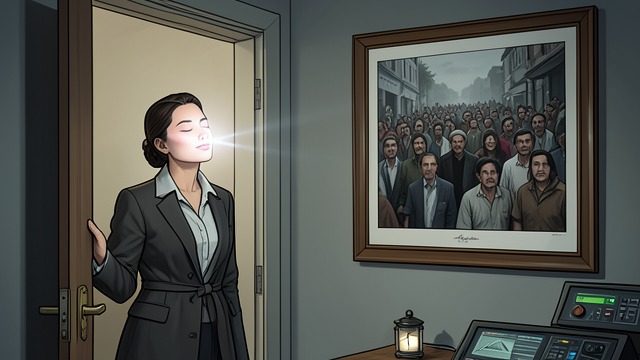
A Moment Preserved
A photograph at the door
A photograph is taken when Liesel returns to the house decades after leaving. She experiences the flash as a brief flare in a world she can no longer see clearly.
The image records a reunion while leaving the subject’s inner experience inaccessible to the camera.
Seeing and remembering
The photograph gives public evidence of a return, but Liesel’s own knowledge comes through memory and sensation. The novel distinguishes an image from the life it records.
The Refugee as Witness
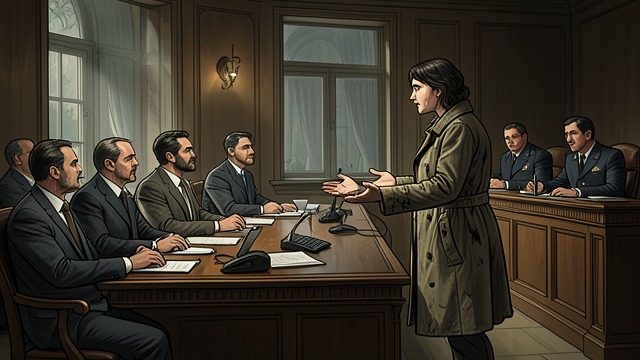
Looking at Displacement
An audience gathers
Refugees are placed before a committee audience to explain their experiences. Their clothes and uncertainty are watched closely, turning the Glass Room into a space of public observation.
Kata’s direct testimony interrupts the audience’s detached expectations.
The ethics of attention
Listening can create solidarity, but staring can turn people into spectacles. The scene asks whether witnessing changes the viewer or merely offers another way to consume suffering.
The Laboratory Camera

The Body Photographed
A standardized image
The biometric centre photographs subjects from set angles after measuring them. The procedure treats the body as a specimen to be compared and classified.
Subjects are told that the records are confidential, but the larger system makes their images part of an administrative archive.
Vision as power
The camera’s apparent neutrality conceals who controls the image and what conclusions will be drawn from it. Looking becomes part of the machinery of racial rule.
The Photograph Reveals an Affair
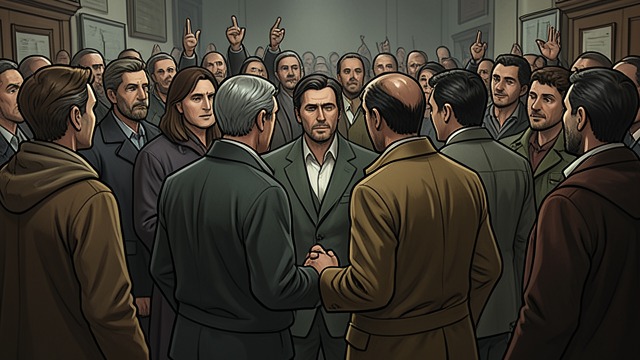
An Image Breaks Denial
Hidden hands
Zdenka notices that Tomáš and Eve are holding hands in a group photograph. Their gesture is partly concealed from people in the room but recorded by the camera.
The image makes visible an intimacy that Tomáš has not admitted.
Evidence changes the relationship
The photograph does not explain what the relationship means, but it removes Zdenka’s ability to treat suspicion as uncertainty. A fixed image forces her to respond to what she sees.
The Family Photograph in 1990
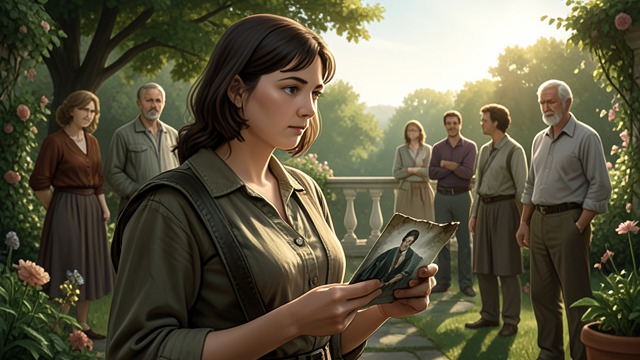
A Picture Carries the Past
The old image
Hana brings a photograph of the Landauers on the terrace. Its worn quality and Liesel’s attentive gaze make the past feel close without making it complete.
Zdenka recognizes the place and learns the faces of the family who once inhabited it.
A new witness
The photograph connects the living occupants to earlier residents. It does not simply illustrate history; it invites the viewer to imagine the relationships absent from the frame.
During Liesel’s return to the house
During the committee meeting in the Glass Room
During the Nazi examinations
After the heritage committee’s group photograph
During Hana’s meeting with Zdenka
